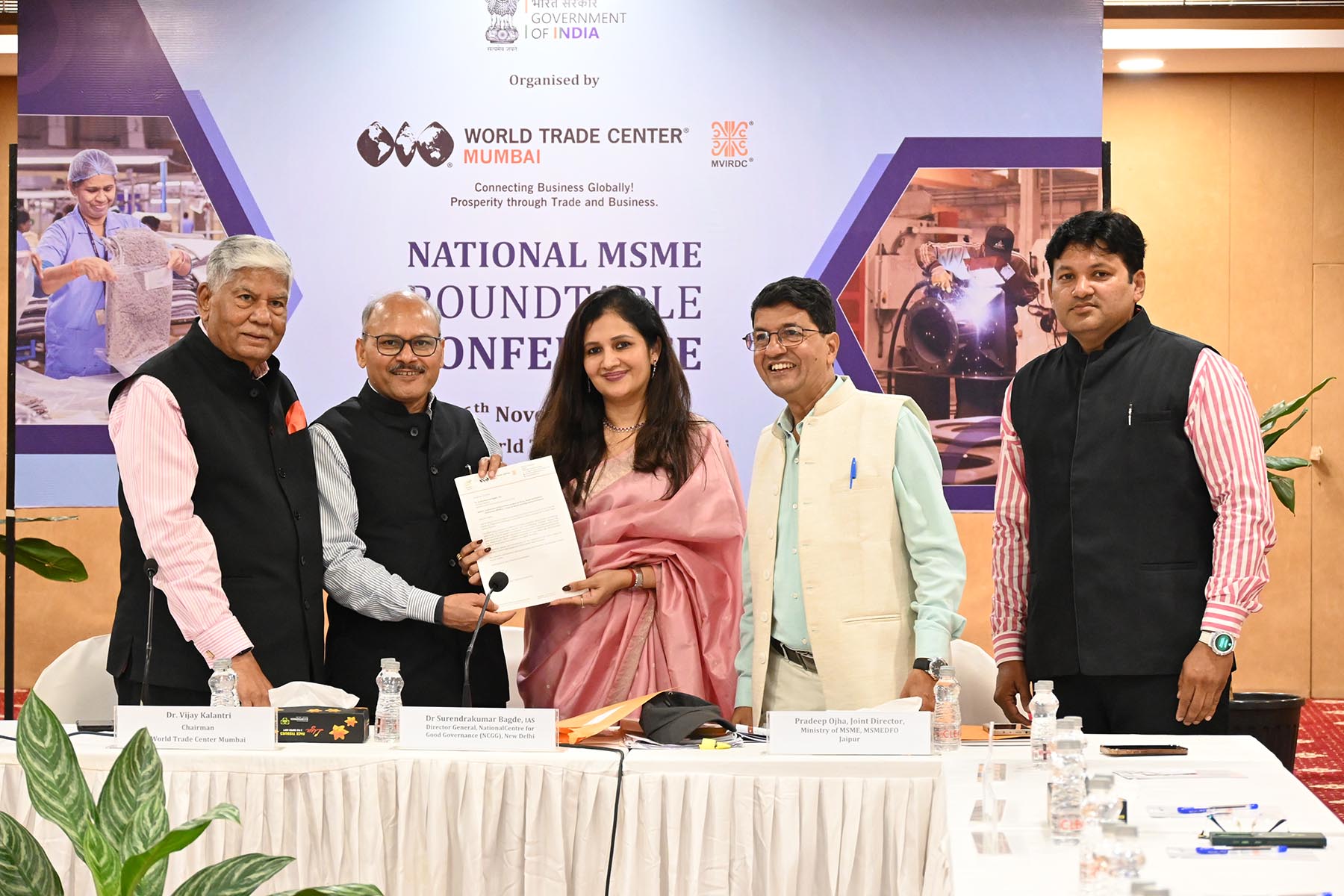
(From Left to right) Dr. Vijay Kalantri, Chairman, World Trade Centre Mumbai and President, All India Association of Industries (AIAI), Surendra Kumar Bagde, IAS, Director General, National Centre for Good Governance; Ms. Priya Pansare, Director, Trade and Investment Promotion, World Trade Centre, Mumbai; Pradeep Ojha, Joint Director, Ministry of MSME
In a significant effort to engage the policymakers with MSMEs on the persistent efforts to boost manufacturing’s share in the GDP and improve ease of doing business, The World Trade Center Mumbai brought together representatives from various MSME associations for a roundtable discussion with Shri Surendra Kumar Bagde, IAS, Director General, National Centre for Good Governance, Shri Pradeep Ojha, Joint Director, Ministry of MSME and Mr. Sagar Kadu, Director Logistics, Ministry of Commerce and Industry, Government of India to discuss the pressing issues faced by small and medium enterprises across the state, particularly deregulation and compliance.
Speaking on the occasion, Shri Surendra Kumar Bagde, IAS, Director General, National Centre for Good Governance, said, “It remains the consistent endeavour of the government to engage with all the stakeholders in the MSMEs sector for increasing the share of manufacturing from the current 15% to nearly 25% to achieve the goal of Viksit Bharat. The government in recent years has come up with numerous initiatives like changing the threshold for MSMEs, scrapping nearly 200 Quality Control Orders (QCO) for intermediate and raw materials, ensuring supply of credit to the MSMEs, new Export Promotion Mission along with rationalization and simplification of obsolete laws to enable a climate of trust between the sector and the government.
He further brought out various circulars and office memoranda issued by the government in the recent past for the betterment of the business climate to the notice of the participants to publicize the initiatives taken by the government, which were hitherto little known to the participants. To make an outreach to the industry, Mr. Bagde further suggested a train-the-trainer initiative for the association which will help dissemination of best practices in the industry.
The issue of compulsory safety audits as per new laws was also pointed out, wherein every unit must undergo a safety audit which is empanelled by the government. With a handful of auditors in place and nearly 60,000 industries operating, MSMEs face the persistent challenge of contravention of law. Responding positively, Mr. Bagde, along with Ms. Namrata Gandhi, Deputy Secretary, Cabinet Secretariat assured the associations on the issue and resolved to make a comprehensive research analysis of number of safety auditors in the whole country and the shortfall of it under the ambit of NCGG.
Dr. Vijay Kalantri, Chairman, World Trade Center Mumbai, President, AIAI emphasised that MSMEs, over 60 million enterprises contributing nearly 30% to India’s GDP and 45% of the exports form the backbone of the country’s industrial ecosystem and must be supported through streamlined processes, transparent governance, and reduced compliance burdens. He also highlighted a major concern among MSMEs: the growing overlap between Central and State regulations, which creates a dual compliance burden leading to confusion, delays, and inconsistent enforcement at the ground level. Dr. Kalantri stressed the need for stronger coordination between Central and State authorities to ensure uniform, predictable, and clearly aligned regulatory processes. He further suggested a system of self-attestation and auto renewal by MSMEs to ensure trust between the industry and government.
He further noted that India currently ranks 63rd out of 190 economies in the Ease of Doing Business index and emphasised that achieving the national vision of Viksit Bharat 2047 and Maharashtra’s goal of becoming a USD 1 trillion economy will require a significantly strengthened Ease of Doing Business framework.
Mr. Kalantri further underlined that aligning state-level procedures with the national objectives of Ease of Doing Business and Make in India is essential for enabling MSMEs to remain competitive in domestic and global markets. Concerted efforts should be made by government in this regard while taking all the stakeholders into confidence.
The discussion revolved around the practical implementation of the rules and regulations of doing business. Various associations pointed out the multiplicity of laws that are ambiguous giving discretionary powers to the bureaucracy. The emphasis on the letter of the law is more prominent on the ground, defeating the purpose of reforms. One such example that was pointed out was the need to take entirely new sets of permissions from the authorities once jurisdiction transfers from one authority to another. This leads to a situation wherein an industry operating for decades has to reapply for new permissions and clearances de novo, hindering business.
Upon being brought to the notice of multiple statutory exemptions for MSMEs, Shri Pradeep Ojha, Joint Director, Ministry of MSME assured the participants to present before the government a case of exemption of all statutory approvals for new MSMEs, as the case is in Gujarat and UP.
The concern of the rapid introduction of Quality Control Orders and BIS certification requirements was also raised. Participants requested a phased implementation, financial support, and adequate preparation time before strict enforcement Many MSMEs lack access to adequate testing infrastructure, forcing them to depend on expensive overseas agencies, which increases production costs and reduces competitiveness. They also highlighted long approval timelines with Customs, particularly for Advance Authorization licenses, which are currently processed centrally in Delhi and often take six months to a year. In response to this Mr. Sagar Kadu, Director Logistics, Ministry of Commerce and Industry, Government of India pointed out,” The government is consistently trying to rationalize the QCOs and enhancing testing infrastructure by public-private partnership. He also emphasised on the Decentralization and faster digital processing adoption by government to deal with this”.
The recently implemented Digital Personal Data Protection Act was flagged as a significant area of concern, with members noting the lack of awareness, high compliance costs, and severe penalties up to 250 crores that may disproportionately affect small enterprises. In response to this, , Ms. Radhika Sarda, Young Professional, NITI Aayog and Ms. Olivia Ruhil, Young Professional, NCGM requested the industry to wait till the final notification of rules which will consist of simplified norms, sector-specific guidelines, and government-led awareness programmes.
Labour compliance challenges also remain, as industries continue to face enforcement under old systems despite the introduction of new labour codes. Participants sought clarity, updated communication, and training for enforcement officers to prevent contradictory demands and harassment.
Several MSMEs shared experiences of receiving GST notices, unpredictable inspections, and facing extortion and misuse of authority at the local level, which create fear and uncertainty for business owners. Across all sectors, members unanimously requested the introduction of self-certification and auto-approval systems for non-critical permissions, a single-window mechanism for addressing grievances across departments, and improved accountability at every level of administration.
Shri Surendra Kumar Bhagde acknowledged the issues raised and assured participants that all concerns and recommendations would be compiled and forwarded to the relevant ministries and state authorities for timely action. He reaffirmed the government’s commitment to reducing compliance burdens, strengthening ease of doing business, and supporting MSMEs in sustaining growth and competitiveness. The meeting concluded with an understanding that continued structured dialogues between MSME associations and government authorities are essential for creating a more efficient, transparent, and industry-friendly regulatory environment.
The roundtable discussion saw participation from representation of major trade and MSMEs associations like WTC Mumbai, AIAI, Laghu Udyog, TISSA, FICCI, RATA, LUB, TTSPL, ASSOCHAM and IEEMA showcasing wide level of participation not only from MMR but also from nearby areas like Thane, Palghar and Raigad.
